


What Is Baccarat?
Overview of Baccarat
Think of this not as a game you play, but rather an event you wager on. You are a spectator with financial skin in the game. On the table, the dealer will form two distinct hands: one labeled the “Player” and the other the “Banker.” You don’t get to hold the cards. You don’t get to tell the dealer what to do.
Your entire involvement consists of tossing your chips onto the betting layout before the round starts. You can put your money on the Banker to win, the Player to win, or you can predict a dead heat (a Tie). After that, you literally just sit back and watch the cardboard fly. It is completely hands-off.
The Basic Objective of the Game
Forget about hitting 21. Forget about forming a royal flush. Everything here revolves around the number nine. The single, unchangeable goal of the round is to guess which of the two hands will finish with a point total that is closest to nine.
There is no such thing as “busting” or going over the limit. The scoring system automatically corrects itself if the numbers get too high. Your only objective is to make an accurate prediction before the betting window slams shut.

A Brief History of Baccarat
Nobody knows the exact day it was invented, but historians broadly point to Italy in the 15th century. Rumor has it that a guy named Felix Falguiere slapped together the first version using a deck of tarot cards, naming it after the old Italian slang for “zero.”
Eventually, French soldiers brought it back to their homeland, where the nobility and King Charles VIII absolutely lost their minds over it. For hundreds of years, it was a closed-door activity for the ridiculously wealthy. It wasn’t until the Las Vegas boom in the 1950s that the rules were simplified for the general public. Fast forward to today, and you don’t even need to leave your couch to access it.
How Baccarat Works

The Role of the Banker and Player Hands
Let’s kill the biggest misconception right out of the gate. The names printed on the table are completely meaningless.
When you sit down, your brain naturally tells you, “I am the player, so I must bet on the Player space.” Wrong. The casino operates the game regardless of where you put your money. “Banker” and “Player” are just two arbitrary titles for the two hands being dealt. You could call them Hand A and Hand B, or Left and Right. You are totally free to bet heavily on the Banker hand, and the house will gladly pay you if it wins.
How the Final Result Is Determined
Here is where the magic happens. You add the cards together. If the total breaches double digits (10 or higher), you simply erase the first digit from existence.
Let’s walk through it. The Banker hand gets a 7 and an 8. Normal math says that is 15. In this universe, you drop the 1. The Banker’s actual score is 5. The Player hand gets a 6 and a 7. Normal math says 13. Drop the 1. The Player’s score is 3. Five is closer to nine than three. The Banker wins. It takes two seconds to calculate, and the dealers are so fast you barely even have to think about it.
Card Values and Hand Totals
If you are coming over from traditional poker, the scoring here will twist your brain for a minute. The game uses standard decks (usually eight of them packed into a plastic shoe), but the printed numbers don’t always mean what you think they mean.
Table 1: How Cards Are Scored
| Card Face | Mathematical Value | Practical Example |
| Ace | Exactly 1 | Pulling an Ace and a 5 gives you a total of 6. |
| Digits 2 through 9 | Face Value | A 3 and a 4 gives you a total of 7. |
| 10s, Jacks, Queens, Kings | Absolute Zero | A King and a 9 gives you a total of 9. The King is invisible. |
Common Baccarat Variations
Punto Banco
If you are gambling online or visiting a mainstream casino floor, this is the version you are staring at 99% of the time. The rules are carved in stone. The dealer handles every single card pull based on a mandatory grid of instructions. The people placing bets have absolutely zero agency. It is purely mechanical, making it incredibly fast and immune to human error.
Chemin de Fer
This is the dramatic, old-school European version. Instead of the casino holding the bank, the players at the table actually bet against one another. Whoever is holding the bank puts up the risk capital. The wildest part? The people involved actually get to decide if they want to pull a third card or stand pat on their current numbers. It involves actual psychological gameplay and bluffing.
Baccarat Banque
Very similar to Chemin de Fer, but slightly more aggressive. The banker position doesn’t rotate around the table after every hand. Instead, whoever wants to risk the most money holds the bank until they either go broke or voluntarily step down. It is highly territorial and usually reserved for massive whales in private VIP rooms in Monaco or Paris.

Differences Between Baccarat Variations
Why does the version matter? Because it dictates exactly how much control you have over your money.
- Autonomy: Punto Banco is a spectator sport. The French variations are interactive bloodsports.
- The House: Online, you fight the algorithm. In Chemin de Fer, you are literally trying to take the guy sitting next to you for everything he has.
- Pacing: Automated games fly by at warp speed. Human-driven games drag on because people take forever to make decisions.
- Availability: You will struggle to find anything other than Punto Banco on digital platforms because the logistics of players banking against each other over the internet are a nightmare.
Baccarat Rules Explained

Natural Hands and Third-Card Rules
Every single hand kicks off exactly the same way. The dealer slides two face-up cards to the Player spot, and two to the Banker spot.
If either of those initial hands totals an 8 or a 9, the game halts immediately. That is called a “Natural.” It’s an instant knockout blow. The dealer checks the scores, pays out the winner, and wipes the table for the next round.
If nobody hits a natural, we wade into the third-card rules. The Player always acts first.
List 1: The Player’s Fixed Drawing Rules
- If the total is 0, 1, 2, 3, 4, or 5: The Player must draw one final card.
- If the total is 6 or 7: The Player must stand and take nothing.
- If the total is 8 or 9: Natural win (or tie). No cards drawn.
The Banker’s drawing rules are a chaotic mess of conditional logic that depends heavily on whatever card the Player just pulled. You do not need to memorize them. The software or the human dealer handles it automatically.
How the Banker and Player Hands Are Compared
Once the dust settles and the strict drawing conditions are met, the hands are locked. The dealer totals them up, slices off the tens digit, and puts the two single numbers head-to-head. Whoever is closer to nine grabs the cash.
Understanding a Tie Result
Every once in a while, the math gridlocks. The Banker hits a 7. The Player hits a 7. When this happens, all bets placed on the Banker and Player spaces are simply frozen and returned to the owners. You didn’t win, but you didn’t lose. However, if you specifically threw chips onto the “Tie” betting area, you are about to get paid out nicely, usually at a ratio of 8 to 1.
Baccarat Odds and Probability
Probability of Different Outcomes
Card distribution does not care about your feelings. It operates purely on statistics. Because the Banker hand gets to act last (after seeing what the Player hand did), it inherently holds a slight structural advantage.
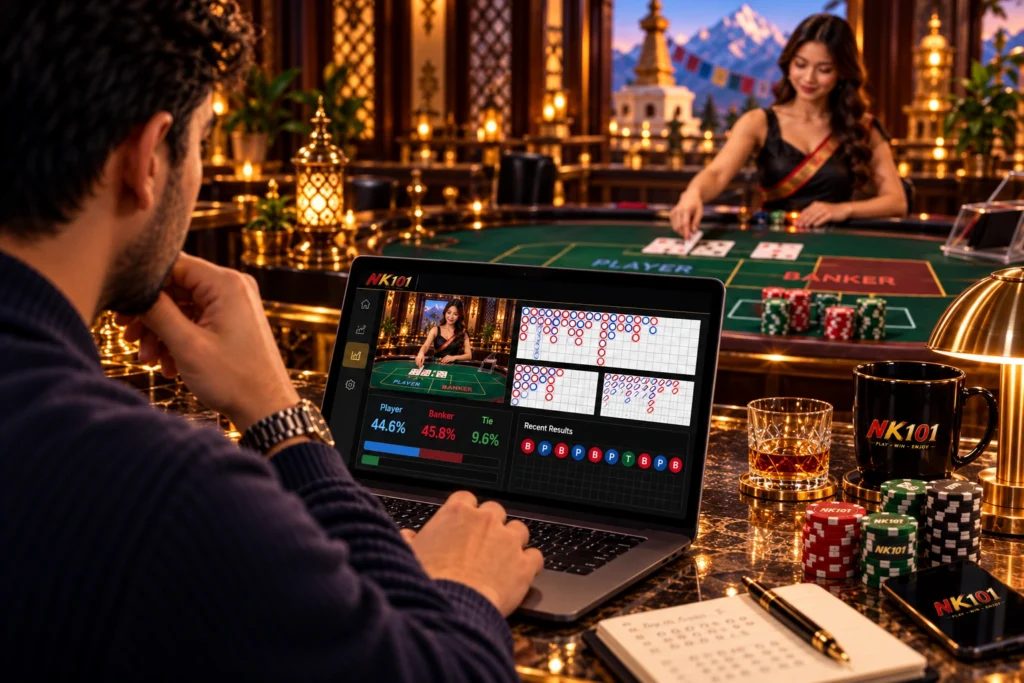
If you run a million hands through a supercomputer, the Banker will win about 45.8% of the time. The Player will win about 44.6% of the time. The remaining 9.6% of rounds will smash into a tie.
Why Past Results Do Not Predict Future Outcomes
Walk through a casino floor and you will see dozens of people clutching pens, furiously tracking every single hand on a piece of paper. Digital platforms feed into this delusion by offering elaborate digital roadmaps charting out historical streaks.
It is completely useless. The deck has amnesia. A streak of eight Player wins in a row physically cannot influence the ninth hand. The cards are heavily randomized. Believing that a Banker win is “due” just because it hasn’t hit in a while is how people blow their entire monthly entertainment budget in twenty minutes.
Understanding the House Edge
The casino is not a charity; they build a mathematical tax into every game to ensure they keep the lights on.
Table 2: The Reality of the House Edge
| Your Chosen Bet | The Built-In House Edge | The Verdict |
| Banker Hand | 1.06% | Statistically, the best place to park your money. |
| Player Hand | 1.24% | Marginally worse than the Banker, but still incredibly solid. |
| Tie Bet | 14.36% | A complete mathematical disaster. Avoid it. |
Wait, if the Banker wins more often, how does the casino survive? They take a 5% commission on all winning Banker bets. So, if you throw down a 1,000 stake and win, you get your 1,000 back, plus 950 in profit. Even with that annoying tax, betting the Banker remains your smartest financial move.
Live Baccarat and Digital Versions

How Live Dealer Baccarat Is Presented
We have reached a point where physical casinos are almost obsolete for the average player. Live dealer tech bridges the gap perfectly. Companies build massive studio spaces that look identical to VIP rooms in Macau. A real human pulls real cards from a physical shoe. Optical scanners read the barcodes on those cards instantly, translating the physical action onto your phone screen in real-time. You get the authentic visual and auditory experience without dealing with drunk tourists spilling drinks on you.
Digital Baccarat and Random Number Generation
If you prefer total isolation and speed, standard RNG (Random Number Generator) tables are the answer. There is no human. A heavily audited algorithm cycles through millions of numeric combinations. The millisecond you tap the “Deal” button, it freezes on a number and translates it into your cards. It is mathematically bulletproof and lets you dictate the exact pace of your session.
Differences Between Physical and Online Formats
The online transition has completely revolutionized how normal people interact with this game. Think about the logistics. Going to a brick-and-mortar spot requires travel, cash, and dealing with high minimum bets.
List 2: Why Digital Platforms Dominate
- Accessibility: Take a modern operation like NK101. You don’t need a formal ID card to walk in; you just handle a quick phone number verification and you are immediately inside.
- Micro-Stakes: Physical tables demand big chips. Online platforms cater to everyone, allowing you to jump in with a minimum deposit of just 100 Rupees.
- Massive Ceilings: If you hit a wild hot streak, the infrastructure can handle it. Digital systems routinely process maximum payout limits stretching up to 100 million without flinching.
- Frictionless Exits: Cashing out at a physical cage takes time. Reliable online setups offer rapid transactions, often clearing a withdrawal in a flat 1 minute, dumping your funds straight back to you in local currency (NPR) with zero fees.
Baccarat Myths and Misconceptions
The Gambler’s Fallacy
This is the psychological bug in the human brain that ruins bankrolls. It is the overwhelming, totally irrational belief that an independent event is somehow influenced by the past. If you flip a coin and hit heads nine times, your brain screams that tails is mathematically guaranteed on the tenth flip. It isn’t. It’s still 50/50. The exact same logic applies here. Stop looking for balance in a freshly shuffled shoe.
Why Betting Patterns Cannot Guarantee Results
Do not pay someone on the internet for a “guaranteed winning system.” They are selling you snake oil.
List 3: Popular Betting Systems That Don’t Work
- Counting Cards: Brilliant for blackjack because a deck full of tens helps the player. Absolutely useless here, because you are strictly bound by the forced drawing rules anyway.
- The Martingale: You lose a hand, so you double your bet. You lose again, you double it again. The theory is one win recovers everything. The reality? You hit a nasty losing streak, max out the table limits, and go bankrupt.
- The Paroli: You only increase your wagers when you are winning, trying to ride a “hot streak.” The problem is, hot streaks only exist in the past tense. You can’t predict them.

Separating Probability From Personal Beliefs
If you ever watch high rollers play, the theatrics are incredible. People will physically bend the cards before turning them over, trying to “squeeze” a good number out of the paper. They will violently blow on their chips to get rid of bad luck. It is highly entertaining theater. Enjoy the rituals, but keep your head grounded. No amount of card squeezing physically alters the ink printed on the cardboard.
Responsible Gaming and Risk Awareness

Understanding Financial Risk
Because there are zero decisions to make once the hand starts, rounds take roughly thirty seconds. That extreme speed means your bankroll can violently swing up or down before you even realize what happened.
You must establish concrete firewalls before you place your first wager. Decide exactly what you are willing to lose, and decide exactly what profit number will make you walk away. The moment you hit your target, utilize that 1-minute withdrawal feature and lock in your win. Do not stick around trying to push your luck.
Recognising Misleading Claims About Guaranteed Wins
The internet is infested with grifters pushing “hacked software” or claiming they can read the RNG code. It is all garbage. Real security relies entirely on the platform’s reputation and encryption. Legitimate operators don’t promise you will win; they promise fair math, transparent limits (like capping deposits and withdrawals between 100 and 2,000,000), and reliable payouts. If it sounds too good to be true, close the browser immediately.
Age Restrictions and Local Legal Requirements
Online environments are strictly fenced off for a reason. You must be over 18 to participate. This isn’t just a suggestion; it is a hard rule.
List 4: Why Verification Matters
- Troubleshooting: If someone tries to hack your profile or your account is temporarily blocked for security reasons, customer support actually knows who they are dealing with and can fix the issue quickly.
- Fraud Prevention: Linking your account to your active phone number stops people from stealing your identity.
- Fund Security: It ensures that when you request a massive payout, the money actually goes to your specific local accounts.