


What Is Roulette?
Strip the tuxedoes out of the James Bond movies, and you essentially have a gloriously dressed-up lottery wheel. The entire mechanism hinges on predicting exactly where a bouncing ivory-colored pill will crash-land. You stare at a massive green fabric grid, predict a specific digit or a basic colour, and push your cash forward. The croupier violently cranks the heavy cylinder one way and whips the ball in the totally opposite direction. Friction always wins eventually. The ball smacks against brass deflectors, drops into a slot, and half the table groans in defeat.
The History and Origins of Roulette
You can officially blame a 17th-century French genius for your late-night betting habits. A guy named Blaise Pascal was obsessing over building a machine that could run forever without an energy source. He failed, obviously, because the laws of physics refuse to bend. But his busted science experiment resulted in a wheel that spun almost without friction.
Bored Parisian elites soon hijacked his prototype for underground betting parties. Fast forward to the 1840s, and a pair of hustler brothers, François and Louis Blanc, realized they could completely monopolize the gambling scene. They ripped the double-zero off the board, set up a bespoke game in the German spa town of Bad Homburg, and laid the concrete foundation for the modern casino empire.

The Role of the Wheel and Numbered Pockets
That polished mahogany bowl isn’t just a fancy table ornament. It is calibrated tighter than a sports car engine. Pit bosses drop absolute fortunes on a single apparatus to prevent any physical bias. If the tilt is off by a fraction of a millimeter, professional bettors will spot the anomaly and clean out the vault.
Inside the track, alternating red and black bays wait to swallow the ball. The tiny metal walls dividing them are called frets. Smacking a fret sends the ball completely airborne, neutralizing anyone trying to use a hidden stopwatch to calculate the final landing zone.
Types of Roulette
French Roulette
Visually, it looks identical to the European setup—37 pockets, single zero. The catch? It hides a massive financial safety net inside the rulebook. If you dump your cash on a 50/50 bet like Black, and the ball cruelly drops into zero, the casino doesn’t just snatch your chips. Thanks to a local rule known as “La Partage,” the dealer hands exactly half your bet back.
European Roulette
If you actually care about keeping your bankroll alive, you sit your lucky self right here. The European layout carries exactly 37 slots: digits 1 through 36 and a lonely green zero. Because you only have one green assassin actively working against your outside wagers, your survival rate over a rough two-hour session is drastically better.
American Roulette
Leave it to American casino bosses to ruin a perfectly balanced game out of pure greed. When the wheel hit the Louisiana riverboats back in the day, operators decided a single zero wasn’t draining pockets fast enough. They glued a double-zero (00) pocket onto the board, bumping the slot count to 38. That tiny structural tweak literally doubles the speed at which the house grinds your chips to dust.

Key Differences Between Roulette Variants
Do not just blindly throw money at the first layout you see. Know your battlefield. Here is the mechanical breakdown of what you are walking into.
| Wheel Style | Zero Count | Total Slots | Built-in Casino Tax | Player Survival Rate |
| European | 1 (Just the solo 0) | 37 | 2.70% | High |
| American | 2 (0 and 00 slots) | 38 | 5.26% | Terrible |
| French | 1 (Just the solo 0) | 37 | 1.35% (on Even plays) | Best Available |
Roulette Wheel and Table Layout
Numbered Pockets and Wheel Colours
Stare at the spinning dish closely. The numbers aren’t sitting neatly in order like a wall clock. The designers scrambled them violently to break up high, low, odd, and even clusters. A red number is almost always boxed in by black numbers to keep the visual chaos at a maximum.
The Difference Between Single-Zero and Double-Zero Wheels
The physical geometry totally shifts depending on what variant you play. On the American layout, they shoved the 0 and the 00 onto exact opposite sides of the bowl to keep the weight distribution perfectly balanced. On the European version, that single zero sits quietly chilling between black 26 and red 32. Folks who try to visually track the ball’s momentum have to entirely rewire their brains if they switch between wheel types.
Understanding the Roulette Table Layout
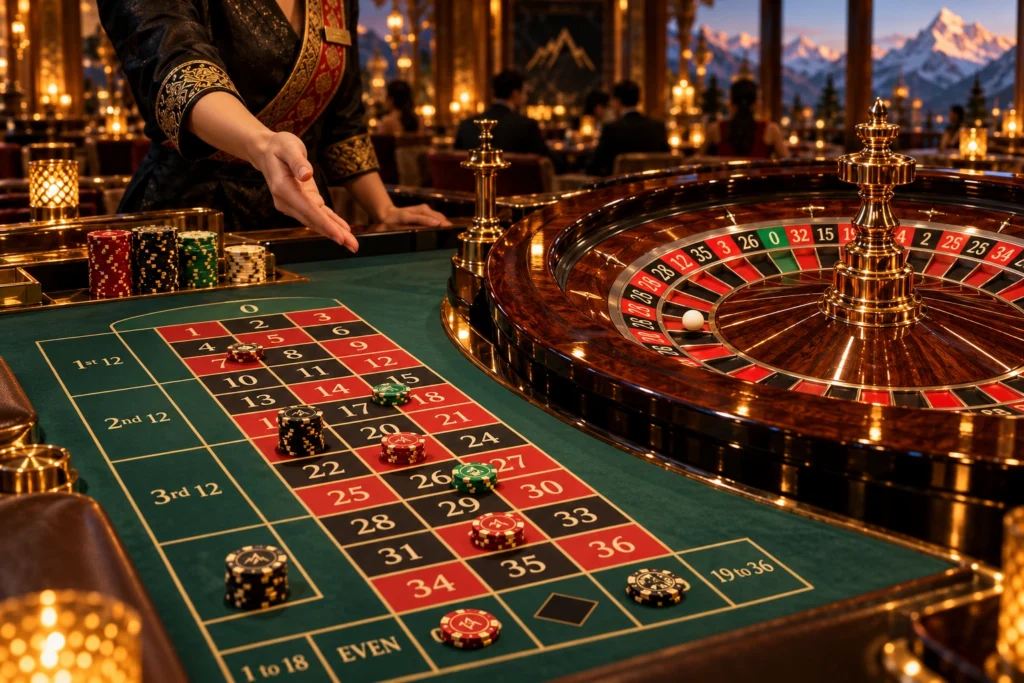
That giant green felt covering the table is your office. It’s chopped into two very obvious zones. The “inside” is the tight, boxed grid showing all the individual numbers. Betting in here means you want life-changing payouts, but you fully accept you will lose 36 times out of 37 on average. The “outside” wraps completely around that grid. This is where you find the safety nets: Red, Black, Odd, Even. You win way more often out here, but the payouts are a measly one-to-one swap.
Roulette Rules and Outcomes

How a Roulette Result Is Determined
A fresh round kicks off the second the dealer clears away the previous losers. You angrily stack chips on your favourite dates while the heavy cylinder starts spinning. Eventually, the dealer wipes a hand flat right across the layout and yells that betting is closed. Try sneaking a chip past them after that warning, and they will swat it right back at you. The ball drops. The dealer plonks a heavy glass dolly marker on the winning digit, sweeps the garbage, and pays out the survivors.
Number, Colour and Other Outcome Categories
You can get weird with your wagers. You don’t have to just blindly pick a single number and pray to the gambling gods.
- Outside Grinding: Playing the slow, boring game by sticking to Red, Black, Odd, or Even.
- Straight Shot: Dumping everything on one solitary digit. Hits almost never. Pays out massively.
- The Split Play: Balancing a chip exactly on the painted border between two adjacent numbers.
- Street Sweeper: Placing your bet on the outer boundary of a row, grabbing three numbers in one single shot.
- The Crosshair (Corner): Nailing a chip dead centre where four numbered boxes intersect.
Why Each Spin Is an Independent Event
Listen closely to this part. That piece of polished wood spinning on the table does not have a memory. It does not care that the last ten drops landed on red. It does not feel bad for your losing streak. If some guy wearing a cheap suit leans over and says “Black is due to hit,” ignore him entirely. Every single time that ball drops, the mathematics completely reset.
Roulette Probability and House Edge
Probability of Individual Numbers
Casinos print money because they understand fractions significantly better than the average tourist. If you bet straight up, the payout is 35 to 1. But on a Euro wheel, there are 37 distinct pockets. The actual true odds against you winning are 36 to 1. The casino only pays you 35. That single missing unit of cash is what buys the casino owner a private jet.
How Zero Pockets Affect the Odds
The green zero is a financial assassin. Say you bet 100 bucks on Black. You have 18 black numbers fighting for you. The casino holds 18 red numbers. Looks like a perfectly fair coin flip, right? Wrong. The green zero isn’t red, and it isn’t black. If the ball lands there, the house violently sweeps every single chip off both the Red and Black betting squares.

European and American Roulette: Probability Differences
Here is the raw, ugly truth about how badly the American double-zero ruins your night out.
| Wager Style | European Hit Rate | American Hit Rate | Standard Bookmaker Payout |
| Straight (1 spot) | 2.70% | 2.63% | 35:1 |
| Split (2 spots) | 5.40% | 5.26% | 17:1 |
| Corner (4 spots) | 10.81% | 10.52% | 8:1 |
| Red / Black | 48.64% | 47.36% | 1:1 |
Understanding Theoretical Return to Player
Gambling bosses use a corporate metric called Return to Player (RTP) to figure out exactly how slowly they will drain your wallet. European tables sit at a 97.30% RTP. American tables crash way down to 94.74%. That means for every 100 dollars you push through an American game, you are mathematically bleeding over 5 bucks into the ether.
Online and Live Roulette

Physical-Wheel Roulette
Nothing truly beats walking into a real brick-and-mortar joint. You get the heavy chips, the background noise, the sheer human drama of it all. But you also have to deal with drunks spilling drinks on your shoes, massive minimum bets on Saturday nights, and waiting forever for folks to figure out how to cash out their winnings.
Live Dealer Roulette
A few years back, tech developers figured out how to pipe a live human dealer from a secure studio straight to your phone screen. You place digital bets on an app, but you watch a real physical ball bounce around a real wheel in real-time. It kills the deep-seated paranoia that a computer algorithm is secretly cheating you.
Digital Roulette and Random Number Generation
Fully digital games abandon physics completely. They use a Random Number Generator (RNG) engine that spits out millions of complex calculations per second to mimic actual chaos.
When you look at modern digital setups, things get highly specific based on regional laws. Take a fresh project launched in 2026 called NK101, which zeroed in heavily on the Nepalese market. When the local government pushed a total gambling ban across Nepal, players immediately jumped to these tailored offshore setups.
Here is exactly how platforms operating in these restricted grey zones handle the logistics:
- Hyper-Local Banking: You deposit and pull cash out strictly in local Nepalese currency (NPR). No messing around with bad exchange rates.
- Frictionless Movement: Withdrawals process in roughly 1 minute flat. Zero hidden processing fees eating into your payout.
- Wild Financial Limits: They let casuals play with minimum deposits of just 100 Rupees. But hit a massive lucky streak? Maximum winning payouts cap at an insane 100 million Rupees.
- Ghost Registration: Nobody wants to upload a passport to a grey-market site. Account security and verification are handled purely through your phone number. No emails, no heavy KYC document uploads upfront just to start playing.
Roulette Myths and Common Misconceptions
The Idea of “Due” Numbers
Casinos put those glowing electronic history boards above the tables for one reason only: to trick your primate brain. You see that the number 17 hasn’t hit in three hours, and your gut screams that it is “due.” Physics doesn’t care about your gut. Nothing is ever due.
Why Recent Spins Do Not Determine Future Results
A flipped coin doesn’t remember landing on heads. A wooden wheel doesn’t remember landing on black. If a table hits red twenty times in a row, the odds of the 21st spin being black remain exactly 48.64%. Thinking the universe owes you a mathematical balancing act will empty your wallet faster than anything else.

Common Misunderstandings About Roulette Systems
Go online and you will find dudes in rented sports cars selling “guaranteed” betting systems. The Martingale is the famous one—you just blindly double your bet every single time you lose.
Here is exactly why these systems are mathematically doomed to fail:
- The Ceiling: Casinos slap maximum bet limits on tables specifically to crush progressive bettors. You will hit the cap and be physically unable to double your next bet.
- Cash Burn: Lose eight times in a row starting with a measly $10 bet, and you suddenly have to wager $2,560 just to win your original ten bucks back.
- The Zero Trap: Shuffling your chips in fancy patterns doesn’t delete the green zero from the board. The house edge always gets its cut eventually.
Responsible Gaming and Legal Considerations

Chance, Uncertainty and Financial Risk
Look at this game exactly how you look at buying a ticket to a boxing match or a rock concert. It is entertainment that costs money. The second you start thinking about the wheel as a way to cover your car payment, you are in deep trouble. Set your limits before you sit down.
Recognising Claims That Promise Reliable Wins
If a hacker actually built a software algorithm that cracked modern RNG casino tech, they wouldn’t sell it to you on a Telegram channel for fifty bucks. They would be quietly gutting offshore casinos from a yacht. Every single guaranteed winning system sold online is a blatant hustle.
Age Restrictions and Local Laws
You have to be 18 to play anywhere, period. But geography dictates the real operational rules. Nepal handed down a brutal blanket ban on online betting in 2026. This forces platforms like NK101 into weird operational corners.
Because they hold absolutely zero official government licenses, the entire ecosystem runs purely on trust and player reputation:
- Starting Up: Registration is totally free via mobile, and grabbing a 50% new user bonus is standard protocol. But there is no free-play demo mode. You pay to play immediately (minimum 100 NPR).
- Security Structure: Without a government commission breathing down their neck, the platform relies on reputation-based security. You screw over players, word spreads online, your site dies. It forces them to play fair.
- Troubleshooting: If your account gets hacked or temporarily blocked, you can’t run to a state regulator. Your only move is hitting up their tech support directly, which operates smoothly in both English and Nepali.